Whitewater Kayaking First-Trip Checklist
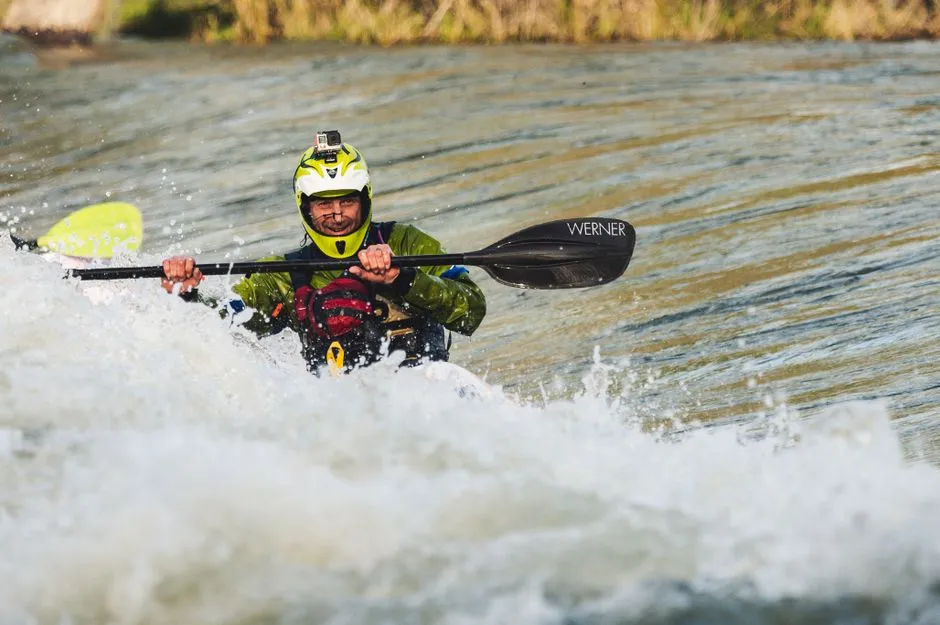
Make the first trip an instructed trip
For a first whitewater kayaking trip, book qualified instruction or join a properly led beginner session. This checklist organizes the decisions to settle before launch; it does not qualify anyone to run a rapid. Flatwater confidence and strong swimming are useful, but they do not teach current reading, a wet exit, self-rescue, throw-rope safety, or how local hazards change with flow.
Settle all of this before the day, not in the parking lot:
- The exact section, named, with its rating on the International Scale of River Difficulty.
- Today's river level and the forecast, including any scheduled dam release.
- Water temperature, from a gauge or report, not guessed from the air.
- Permits, local rules, put-in, take-out, and any mandatory portage.
- Known hazards on that section, plus escape and access points.
- Group roles, signals, and the emergency plan.
Match the route to the least experienced paddler
The scale has a name, so use it. The International Scale of River Difficulty runs Class I to Class VI:
- Class I — easy. Fast water with riffles and small waves, obvious channels, few obstructions.
- Class II — novice. Straightforward rapids with wide, clear channels that can be scouted from the boat.
- Class III — intermediate. Irregular waves, tight passages, active maneuvering required.
- Class IV to VI — advanced through extreme, with serious to severe consequences for a swim.
A first trip belongs on Class I–II water. Class III and above assume a reliable roll or a competent self-rescue swim in a rapid, and neither is true on day one.
A rating describes technical challenge at a normal level, not the consequences on the day. Flow, debris, weather, visibility, dam releases, and recent channel changes all move those, and a Class II section at twice its usual flow is not a Class II day. Check the managing authority on the morning of the trip. The National Park Service river-safety guidance emphasizes changing levels, flash floods, strainers, undercut rocks, foot entrapment, hydraulics, cold water, and remoteness.
Do not paddle alone. Agree who leads, who sweeps, how the group keeps one another in sight, and what signal means stop, scout, or get off the river.
Browse trip planning for more conservative pre-launch habits.
Wear a life jacket that is approved and fitted
- The life jacket must be U.S. Coast Guard-approved. On most U.S. waters this is a legal requirement, not a preference, and the approval is printed on the label.
- Choose one sized for the paddler's weight and chest, and rated for paddling use.
- Fasten every buckle and adjustment as designed.
- Check the fit before every launch: a foam life jacket should fit snugly, and when someone lifts it by the shoulders it should not ride up above the wearer's chin or ears. Inspect the current label and follow its instructions.
- Replace a jacket with torn fabric, compressed foam, or failed hardware. It is a flotation device, not a keepsake.
Wear a properly fitted helmet designed for whitewater, and secure closed-toe footwear that protects the foot and stays on in current.
Dress for the water temperature
Dress for immersion in the actual water, not for the air beside it. These thresholds are the ones the decision turns on:
- Below about 60°F (15°C), treat the water as cold. Cold-shock risk rises sharply below this point: an involuntary gasp, hyperventilation, and a sudden loss of breathing control at the moment of immersion.
- Add air temperature to water temperature: if the total is under 120°F (a summed threshold — about 31°C when both readings are in Celsius), wear a wetsuit or drysuit. A warm afternoon does not make 50°F water warmer.
- Remember 1-10-1. Roughly 1 minute to get the gasp reflex under control, roughly 10 minutes of useful muscle movement before hands and arms stop cooperating, and roughly 1 hour before hypothermia brings on unconsciousness. Self-rescue happens inside those first 10 minutes or it usually does not happen.
- Match the garment to those numbers: a wetsuit for moderately cool water, a drysuit with insulating layers at and below about 50°F (10°C), or when swims may be long or repeated.
- Avoid cotton as a cold-water layer. It holds water and insulates poorly when wet.
- Carry warm dry layers in waterproof storage, secure eyewear, and remove anything that can snag.
Check the boat and group equipment
- A whitewater kayak that fits, with sound outfitting: foot support, seat, back support, grab loops, drainage, and flotation.
- A wet exit demonstrated before launch, with an instructor watching. No improvised straps or footholds — nothing that can hold a leg.
- A sound paddle, and a spare for the group.
- First-aid and repair supplies, communication and signaling devices, and navigation information.
- Rescue equipment carried by people trained to use it.
A throw rope is not a magic accessory. Incorrect use can endanger both rescuer and swimmer; learn rope handling, belay choices, release decisions, and entanglement avoidance in a practical rescue course before one goes on your harness.
Read safety skills before choosing what to practice.
Rehearse before entering current
On controlled water, demonstrate a wet exit, boat handling, group signals, and the response to a capsize. Settle when to hold or release equipment, how to stay upstream of a loose boat, and where the recovery zones are.
Review our whitewater swimming guide as vocabulary, then practice the defensive position and active swimming in a controlled setting first. Moving water is not the classroom in which to meet these ideas for the first time.
Use a final go or no-go check
- Count people. Count them again at the take-out.
- Fasten equipment and confirm every buckle.
- Compare the observed river with the plan, and confirm that everyone is free to decline.
- File a float plan with a responsible person who knows the route, group, vehicle details, expected return, and when and how to seek help.
- Thunder means leave the water immediately and shelter. Stay sheltered for 30 minutes after the last audible thunder before relaunching. One distant rumble does not buy you a two-minute pause.
- Cancel or change the trip when the level, weather, water temperature, access, equipment, group health, or skill match is wrong.
- Alcohol or other impairment has no place in a whitewater plan.
The best first-trip story is not a heroic recovery. It is a well-led day in which the group learns, turns around when needed, and returns with exactly the same number of paddlers it counted at the start.